





Eye For Film >> Movies >> Mortician (2025) Film Review



Iranian-born director Abdolreza Kahani was awarded the Sean Connery Prize at Edinburgh International Film Festival and he also picked up The Dissident Award from The Besties, which gives gongs across and throughout the festival. In an acceptance statement, he noted: “One-person cinema is a form of resistance: against forgetting, against censorship, and against loneliness”.
The “one-person” element refers to the multi-hyphenate nature of his approach – in addition to writing, directing and producing, he also acts as his own editor and cinematographer, shooting his films on an iPhone. In short, the £50,000 purse that comes with the Sean Connery prize could go an awful long way in his hands.

As with his fellow countryman Jafar Panahi, whose ‘non-films’ were also acts of protest, the low budget nature of Mortician only serves to emphasise the skill and inventiveness of Kahani, who is currently living in exile in Canada. Like Panahi, Kahani is also interested in scrutinising the oppression of the Iranian regime and the long-reaching impact it has even on those outside the country.
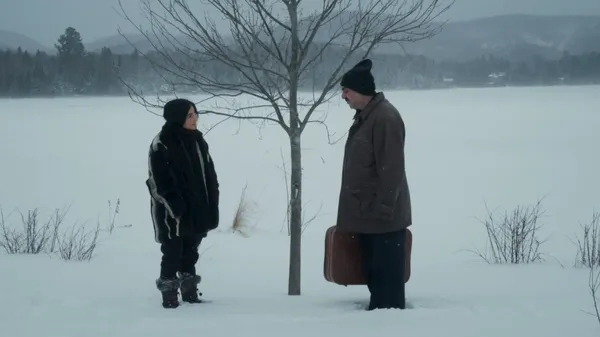
The mortician of the title is Mojtaba (Nima Sadr, who featured in Kahani’s previous A Shrine, which screened at EIFF last year). Mojtaba is a man of few words whose mournful aspect is in keeping with his job of washing the dead for burial and could have been tailormade for the wintry Canadian backdrop this film is set against. He leads a solitary and largely on-the-road life, with the majority of the money he earns sent back to family in Iran.
His job comes under threat at the same time as he comes into contact with dissident singer Jana (singer Golazin Ardestani, who records under the name Gola). She has decided to end her life as an act of protest and wants Motjaba to wash and bury her body – even though both of these things are unorthodox. Although he has deep reservations about her intentions, the prospect of continuing his cashflow home is enough to make him agree.
As other characters come and go, including a man who thinks being washed while alive will cure his insomnia, the relationship between the extroverted Jana and reserved Mojtaba increases in weight. This may be a two-hander but the constantly inventive framing from Kahani ensures that conversations never feel dull and his employment of light is impressive. His mostly locked off shots feel formally rigorous and he not only varies the height of the camera, so that the perspective on the characters shifts, but often uses mirrors to place characters in the frame at once, avoiding any shot/reverse-shot doldrums.
Motjaba’s acquiescence is notable throughout, not only in his frequent “yes” response to those around him but also in terms of his actions, as we learn praying is essentially something he does because of his job rather than due to religious devotion. He emerges as selfless in other ways, however, and as Kahani’s film takes a turn for darker territory, we’ll learn that sacrifice comes in many forms.
Reviewed on: 26 Aug 2025



Director: Abdolreza Kahani
Writer: Abdolreza Kahani
Starring: Nima Sadr, Gola, Pouya Razavi, Erfan Bokaei
Year: 2025
Runtime: 95 minutes
Country: Canada
Search database:
